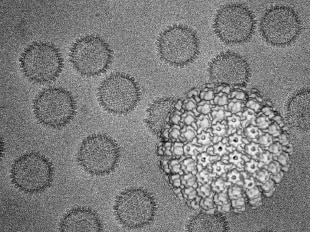
If you've heard of Watson and Crick it's likely becaues of their most famous structural discovery: that DNA comes in the form of a double-helix. But what you may not know is that before this they worked out the structure of tiny viruses. They figured out that an optimal shape for such a virus should be icosahedral, like the shape of a dice in Dungeons and Dragons if you can picture that. I find that rather surprising, an animal (of sorts) that has such a high degree of symmetry.
That viruses come in such interesting geometrical shapes leads to pretty interesting questions you can ask: for example, what sets of shapes are possible? (I studied this in graduate school.) Or what makes one shape preferable to another? And it just blows my mind that a couple of guys figured this out with just a few charts and a little bit of deductive reasoning. I want to explain how they got there.
But first let me take a step back. Today we're so accustomed to seeing beautiful images of viruses — think COVID19 — that we take their unusual geometry for granted, with their sharp, faceted sides, vis-a-vis other cells like yeasts and bacteria which are typically smoother and more regular. Viruses, it turns out, lie on a bridge between physics and biology. Viruses can be so regular, and so symmetrical, that they can form literal crystals, like salt. They can even form liquid crystals like the ones in your laptop or phone screen.
We learned as much in 1935. A mysterious disease was killing tobacco plants in the United States. To find the cause, we pulverized and centrifuged the plant matter which resulted in a gel with odd optical properties -- the kind you only see when a material is made of small rods. (This is called birefringence.) These small rods were what caused the disease. They were what we now call the tobacco mosaic virus.
The way the light scatters through a material, called its diffraction pattern, can tell us about the structure of that material. So in that same experiment, we illuminated those liquid crystals with X-rays. The scattered light came out in a hexagonal pattern, meaning that the little rods had to have some kind of triangular pattern to them, or were perhaps made of triangular units, placed in a repeating pattern. Unfortunately, these patterns only give you a kind of abstract representation of the features the light has scattered through. To get the shape of those features, you have to somehow invert the image -- only possible with a computer (which didn't exist) -- or have a lot of experience and intuition about which shapes produced which patterns.
Nevertheless, the sharpness of the diffraction patterns pointed to highly regular shells -- possibly identical atom-for-atom -- and viruses that had some sort of structural symmetry even on an individual basis. This got a lot of people thinking about what, exactly, that shape could be.
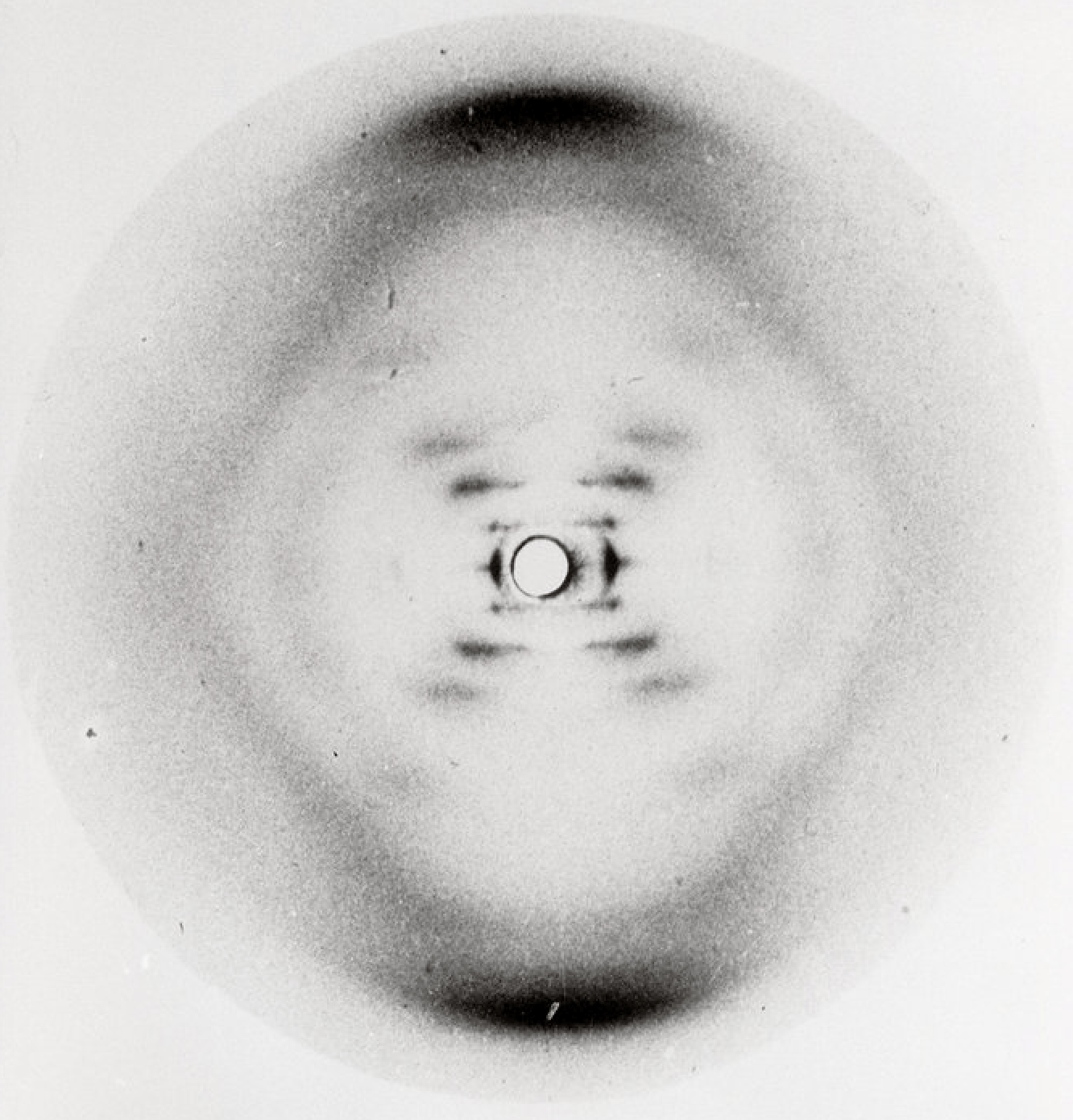
By the 1950s we began making better guesses about the shapes underlyind diffraction patterns. Dorothy Hodgkin, a Nobel prize winner in her own right, thought that because the patterns she saw had cubic symmetry that the viruses must be cubic or octahedral. (It's not so hard to see that the octahedron is dual to the cube -- if you add vertices at the center of a cube's faces, you get two tetrahedrons on top of each other, or an octahedron.)
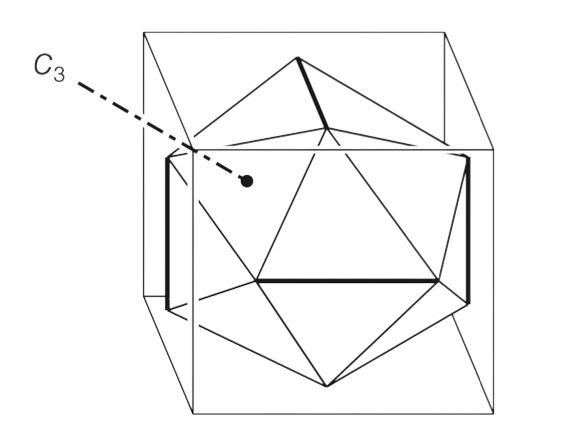
Both of these guesses were reasonable, but turned out to be wrong. it's far from intuitive, but an icosahedron also has cubic symmetry, even though it doesn't look much like a cube. Still, they can form cubic lattices. Unlike Dorothy, both Watson and Crick knew this, and I sometimes wonder it's because of all the toys and cardboard they played with.
It was this, plus hints of five-fold symmetry, that resulted in one of the coolest arguments in theoretical physics history -- they argued from first principles that the smallest viruses would probably be be icosahedrally symmetric.
Given the small known weight of the smallest viruses, and the fact that RNA made up only a small fraction of the total weight, they inferred that the whole genetic code of the virus couldn't be much more than a few thousand base-pairs long — just enough to code for one protein. So, they reasoned, the entire thing must be made of just one protein, and that protein must be the protective coating around the comparatively fragile RNA.
But this raises a dilemma. Proteins, being lumpy and irregular, don't typically feat neatly together to form a closed surface. Instead, they look more like jigsaw puzzle pieces. It becomes hard to picture how to fit together a bunch of irregular shpaes into a single, closed, symmetrical one.
The key insight that Watson and Crick had was that a necessary condition for a symmetrical shape was that the local environment of each subunit had to be the same. If you were standing on a single one of the protein subunits that made up the viral shell, you should have the same view no matter which subunit you're standing on. One such shape is a coil (or a helix). If you take an irregular protein and arrange it into a coil, all the proteins will have the same local environment (apart from the ends.)
And there are two main ways, they discovered, to have every protein have the same local environment: you can arrange them in rods, or arrange them in balls, with different shapes of the subunits favoring different geometries. The ones which preferentially form rods are just those kinds of viruses that form liquid crystals, like the tobacco mosaic virus.
For the viruses that didn't form liquid crystals, the condition that every subunit lives in the same environment as every other one left only a handful of options for how these objects could be arranged: the Platonic solids. Notice how for these surfaces, every vertex and face is indistinguishable from all the others.
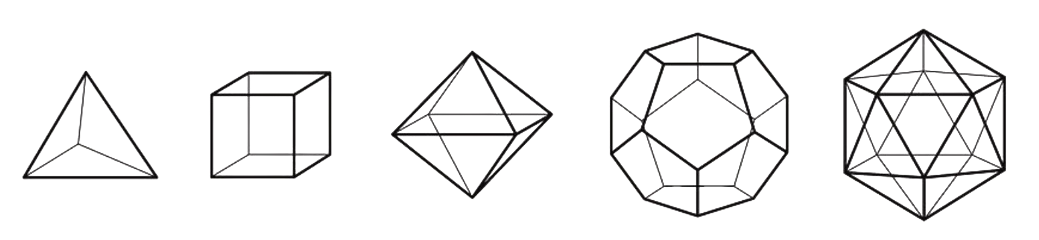
Looking at the different shapes, you can see that there is one that stands out as particularly likely to accommodate the RNA/proteins: the icosahedron (far right). Its relative roundness and large number of facets accommodates proteins which are the smallest compared to the overall size of the DNA. And this was the essential prediction of Watson and Crick, that viruses should have this insanely high degree of symmetry.
Five years later, images like this were published:
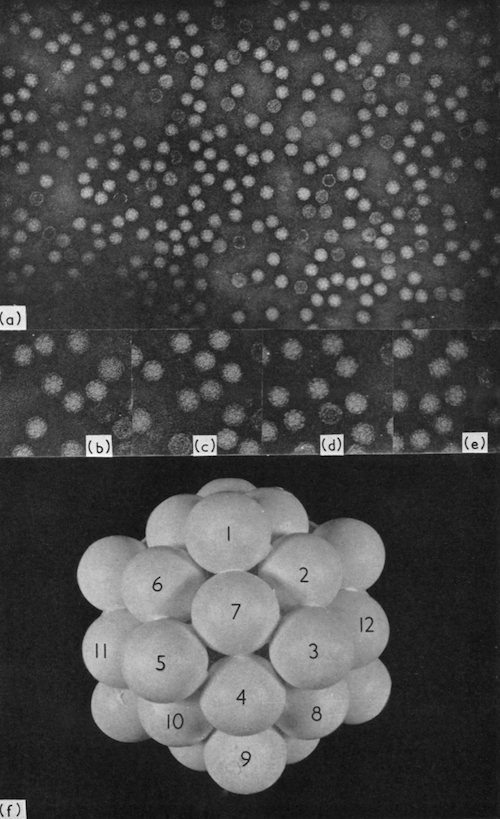
How Einsteinian to be able to predict such a thing: that the smallest organisms to exist should be crystalline, and icosahedral at that.
That the analogy to crystals was so compelling plays a large part in why I dropped out of my PhD.
I ended up working a mathematical model of virus formation that threw away most of the governing physics: the RNA, the proteins, everything physical. It was a gamble on a high-level, abstract theory of shell formation. My advisor's idea was to consider smooth, spherical shells that slowly deform into complex shapes as they buckle or cool. It was part of a program of applying an old but successful theory from the 1930s about particular kinds of matter-to-matter transitions to a new domain where the limits of the theory weren't known. Had it worked, it would have been huge.
I spent about a year doing the calculations and learning group theory, representation theory, spherical harmonics and all that. At the end, I could confidently say our model did reproduce the shapes we expected — but unfortunately, it also reproduced every other round you could possibly imagine, depending on the parameters you put into the model. We didn't have any way of knowing which parameters ought to be godo or bad except by the results they gave us. So we were reasoning circularly: we know the model worked because we could choose the right parameters to give us shapes that looked like viruses, and we knew the parameters had to be correct because they gave us the right shapes. Of course, we could have said the same for any shape. We could have put different parameters and gotten cubes, or needles, or the wind patterns on Jupiter. There was no reason our theory couldn't apply to those shapes too.
When my advisor insisted I publish this work, we had a blow out, where we argued about whether our results were right (I was in the "they're not even wrong because we don't even make a prediction" camp). This led to a mutual breakup. I stand by that decision, but as far as I know he's still pursuing this.
In hindsight I think he was after some kind beautiful mathematical argument à la Watson and Crick, some other fundamental reason for why we see what we see. It's the kind of thing every physicist dreams of discovering. Who knows, maybe some day he'll find it.
Comments
Gabrielle: So you're telling me herpes is actually sacred geometry?